NewSpace Winter School
Date: February 10-14, 2026
The NewSpace Winter School, organised by Espaço ao Cubo, is a week-long course designed for university students with an interest in Physics, Engineering, Space Technologies, Management and Space Law.
Where:
- Feb 10-12 - Faculty of Sciences of the University of Lisbon - Building C8 (Rooms 8.2.39 (Lectures) and 8.2.10 (Workshops))
- Feb 13-14 - Communications Museum
About the Program
Over a period of five days, participants will take part in themed lectures and workshop sessions focused on the main pillars of the NewSpace ecosystem. Each block combines theoretical foundations with practical learning, fostering technical knowledge, interdisciplinary thinking and creative problem-solving skills.
Thematic Blocks
🔭 TELESCOPES
Explore space observation through an approach focused on instrumentation and astrophysical research, engaging with telescope systems, data collection and scientific analysis.
🛰️ SATELLITES
Address the main satellite development processes and the current NewSpace trends, covering design, orbital mechanics and modern applications.
🌐 DOWNSTREAM
Dedicated to the applications of satellite data, focusing on the practical use of space-based information for technological, commercial and sustainable solutions.
🚀 LAUNCH SYSTEMS
Explore the various existing launch vehicles, with a special focus on emerging technologies and their role within the NewSpace sector.
📈 BEYOND ENGINEERING
A cross-cutting block covering management, science communication, entrepreneurship in science and space law, enhancing participants' understanding of the broader space industry.
💡 HACKATHON
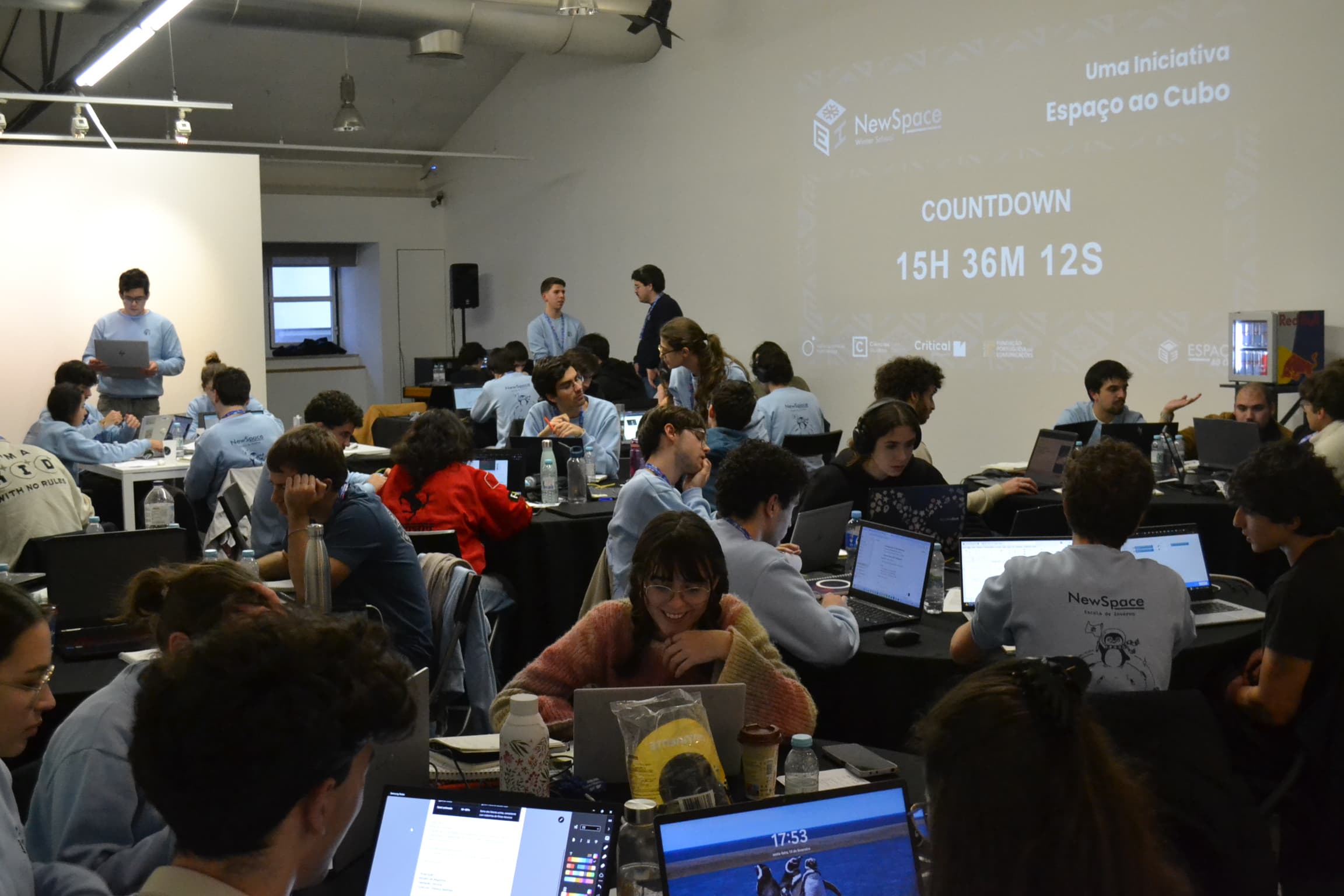
The Winter School concludes with a 24-hour Hackathon, where multidisciplinary teams apply the knowledge acquired throughout the week to develop a creative NewSpace-related project.
Schedule
.png)
.png)
.png)
.png)
.png)
.png)

Speakers
Telescopes
FEB 10 - 15:00 - Lecture
.png)


André Moitinho
Astrophysics Professor - FCUL & LIP
View Bio & Lecture Details
FEB 10 - 15:00 - Lecture
Lecture Title: Telescopes: technology that extends our senses to explore the Universe
Abstract: Telescopes are fundamental instruments of astrophysics, allowing us to observe the Universe far beyond the capabilities of the human eye. This presentation discusses the physical principles governing their operation, the main types of telescopes, and how technological advances on Earth and in space have shaped major astronomical discoveries.
Biography: Professor at the Faculty of Sciences of the University of Lisbon and researcher at the Laboratory of Instrumentation and Experimental Particle Physics (LIP). He is a specialist in the study of the Milky Way and data science. He coordinates national participation in the Gaia mission of the European Space Agency (ESA). His recent work includes the production of maps of the Milky Way using measurements of nearly two billion stars, which became the iconic images of the Gaia mission.
He was president of the Portuguese Astronomical Society from 2010 to 2022. Between 2016 and 2022, he was director of the "Astronomy & Astrophysics" journal, one of the world's leading professional astronomy journals. He has served on several international committees, notably those of ESA and ESO (European Southern Observatory), where he worked on defining scientific priorities and the development of telescopes, instruments, and space missions. He was a member of the United Nations Committee on the Peaceful Uses of Outer Space (COPUOS), where he joined the group of experts on space debris, contributing to the definition of the Guidelines for the Long-term Sustainability of Outer Space Activities.
FEB 10 - 15:45 - Lecture


Ricardo Ferreira
Optical Instruments Engineer - N3O
View Bio & Lecture Details
FEB 10 - 15:45 - Lecture
Lecture Title: Optical instruments in NewSpace
Abstract:
- Specific needs and requirements for Earth Observation mission telescopes
- Accommodation of a telescope on a satellite and interactions with other subsystems
- Differences between a NewSpace and "OldSpace" mission, commercial and scientific
- Ground testing and characterisation
Biography: He began his academic career at Instituto Superior Técnico (IST), University of Lisbon, where he completed an Integrated Master's in Technological Physics Engineering. During his master's, he specialised in Plasma Physics, with a dissertation focused on the laser ignition system of the European Shock Tube for High-Enthalpy Research (ESTHER) for the European Space Agency (ESA). He entered the doctoral program at the Institute of Plasmas and Nuclear Fusion at IST, where he continued to collaborate with ESA's ESTHER project. During his doctorate, he participated in the validation and qualification campaigns of the combustion driver, vacuum system, and spectroscopy and interferometry diagnostics, as well as the design of various parts for subsystems. Since 2024, he has been working at N3O, where he is one of those responsible for the analysis and testing of the optical instruments for the VHR (Very High Resolution) satellites for Earth Observation as part of the PRR for the Atlantic Constellation.
FEB 10 - 17:00 - Workshop


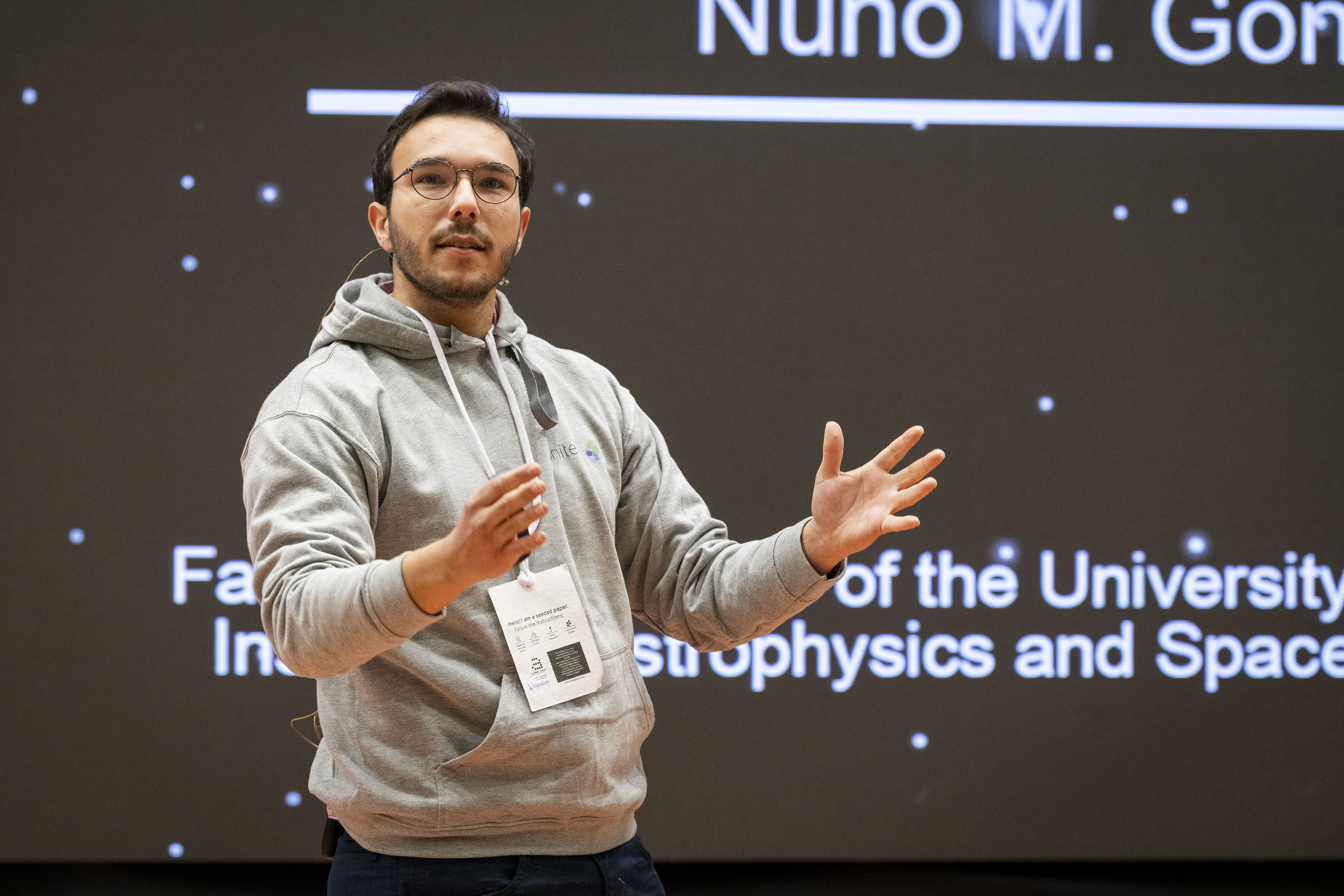
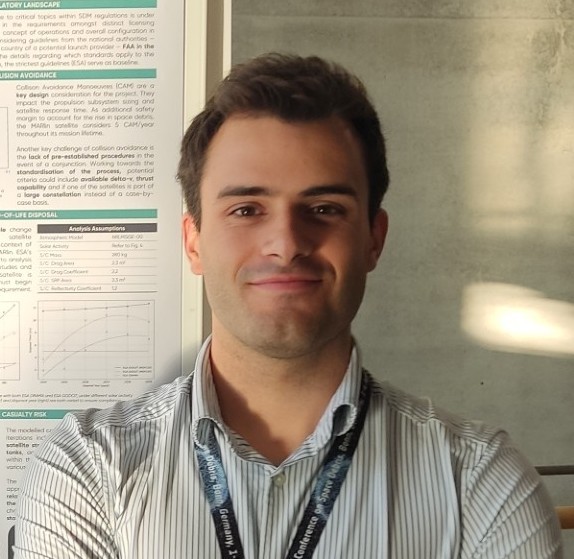
Nuno Gonçalves
Research Assistant - FCUL & IA
View Bio & Workshop Details
FEB 10 - 17:00 - Workshop
Workshop Title: Introduction to optical design of space telescopes
Abstract: The objective of this workshop is to provide participants with an overview of telescope models currently used in astronomy applications in ground and space observatories. It aims to empower participants to understand the trade-offs between telescope focal length, field of view, spatial resolution, and radiometric budget and apply them according to their scientific case. During the workshop, participants should be able to perform an initial approach to the optical design of a telescope that can be used in their projects.
Biography: Completed his master's in Physical Engineering in December 2020 at the Faculty of Sciences of the University of Lisbon. He conducted his master's dissertation at the Institute of Astrophysics and Space Sciences, in the area of optical instrumentation and metrology. After the thesis, he was invited to join the Instrumentation team of the Institute of Astrophysics and Space Sciences as a research assistant, where he worked on two ESA missions: the ATHENA and PLATO missions. On the ATHENA mission, he was responsible for the laboratory work associated with the engineering model of one of the spacecraft's subsystems, the onboard metrology system. On the PLATO mission, he was responsible for the construction, verification, and testing of a room-temperature collimator as part of the ground support equipment for the mission. Currently, he is pursuing a PhD in Physical Engineering at FCUL, with a thesis titled "Towards the miniaturization of cross-dispersed echelle spectrographs." He is also an invited assistant at FCUL, where he teaches laboratory classes for the curricular units of digital circuits and systems, electronics and analog systems, and measurement engineering for undergraduate and master's students. He also continues his work as a research assistant, performing optical design for projects related to Earth and space observatories.
🌙 FEB 10 - 20:30 - Night Observation
Ajuda Astronomical Observatory
Satellites
FEB 11 - 09:30 - Lecture


João Oliveira
Assistant Professor - Instituto Superior Técnico
View Bio & Lecture Details
FEB 11 - 09:30 - Lecture
Lecture Title: Space environment and satellite design
Abstract: The space environment in which a satellite operates during its mission, whether in LEO, MEO, or GEO orbits, influences the design of many of its subsystems. In this presentation, some of the most important characteristics of the space environment will be mentioned, relating them to the design and testing of satellites, including: structural loads and vibrations during launch; atmospheric drag and mission duration; atomic oxygen erosion and protection of exposed surfaces; thermal environment and passive and active thermal control; collisions with space debris and micrometeorites; radiation environment and protection; satellite reentry and design for demise.
Biography: João Manuel Gonçalves de Sousa Oliveira holds a degree in Physics from the Faculty of Sciences of the University of Lisbon, and a Master's and Doctorate in Mechanical Engineering from Instituto Superior Técnico. He has been an Assistant Professor in the Department of Mechanical Engineering at Instituto Superior Técnico since 2004. His recent research interests include drone rotor noise, aeronautical noise prediction near airports, space launch noise prediction, and aerodynamic drag reduction for VLEO satellites. He currently teaches the courses of Orbital Mechanics and Space Environment.
FEB 11 - 10:15 - Lecture


Pedro Prates
Mission Analysis Engineer - N3O
View Bio & Lecture Details
FEB 11 - 10:15 - Lecture (Part 1)
Lecture Title: Mission Analysis for N3O VHR Satellites
Abstract: We will explore the fundamentals of Astrodynamics and Mission Analysis with a focus on Phases 0/A. The presentation will also demonstrate the work carried out so far at N3O on the PRR Atlantic Constellation missions with a focus on Mission Analysis and Systems Engineering. To conclude, I will share my experience and some advice on how to enter the space industry.
Biography: He began his journey in space at the University of Southampton, where he studied for a Master's in Aerospace Engineering with a specialisation in satellite development. He completed two internships and participated in CanSat USA and other space projects (such as the development of a propulsion system for satellites). After completing the course, he worked on Phase 0/A of a mission to develop an interplanetary CubeSat. Currently, he works at N3O, based in Matosinhos, where he primarily performs Mission Analysis, with support in Systems and AIT. At N3O, he has been developing two VHR (Very High Resolution) satellites for Earth Observation as part of the PRR for the Atlantic Constellation.


Vasco Amorim
AIT Engineer - N3O
View Bio & Lecture Details
FEB 11 - 10:15 - Lecture (Part 2)
Lecture Title: Mechanical Engineering in Phases C and D of a Satellite
Abstract: Analysis of Phases C and D of satellite development, with a focus on the mechanical component. The presentation will address design, integration, and testing, including structure, mechanisms, MGSE, and AIT operations, as well as the main challenges encountered during these phases. Examples of the work developed at N3O within the scope of the VHR satellites of the Atlantic Constellation (PRR) will be presented.
Biography: Always with a strong interest in mechanical engineering, he began his training with a technical course in mechatronics. He developed practical experience in design and manufacturing through the mechanical development of hospital equipment. Subsequently, he joined a research laboratory associated with FEUP, focusing on the characterisation of composite materials and participating in the co-authorship of scientific articles on the subject. Currently, he works at N3O, a satellite integrator based in Matosinhos. He began his duties as a Systems Technician and, after completing his degree in Mechanical Engineering, assumed responsibilities as an AIT Engineer. His work focuses on the development and use of MGSE, the definition and execution of critical satellite integration and test operations, including assembly, environmental campaigns, and transport, as well as supporting systems activities.
FEB 11 - 11:30 - Workshop


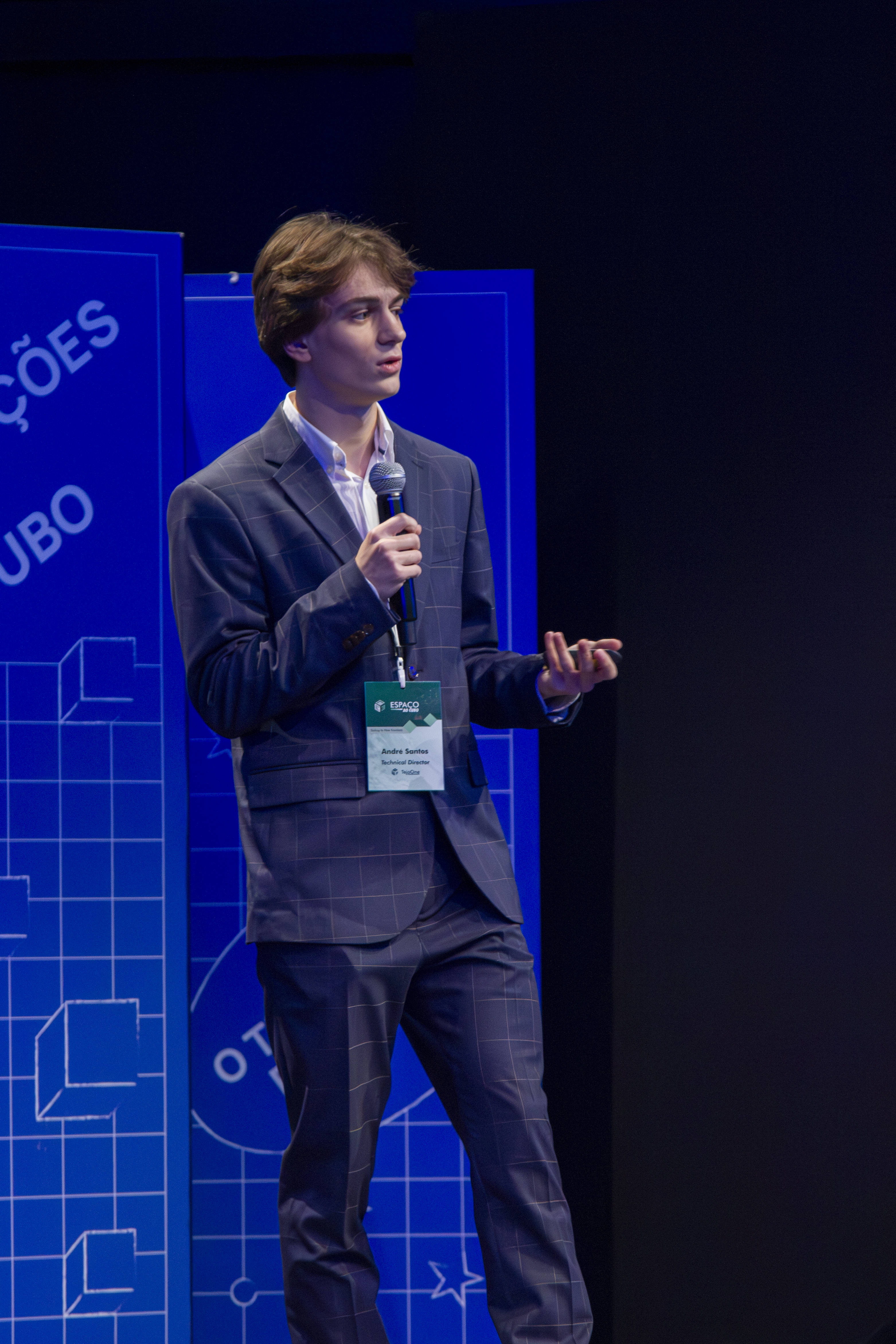
André Santos
Techinal Director - TejoOne & Espaço ao Cubo
View Bio & Workshop Details
FEB 11 - 11:30 - Workshop
Workshop Title: Mission Design: Practical introduction to satellite systems engineering
Abstract: Systems Engineering is the discipline that ensures that a complex project must finally work, ensuring that all the pieces of the puzzle fit perfectly. In this workshop, we will focus on Phase 0/A, the initial moment where the failure is unsuccessful and where the success or failure is defined. You will learn to transform vague objectives into solid technical requirements, anticipating risks and guaranteeing the viability of the miss before building the first prototype.You will be challenged to take on the role of Systems Engineer to plan 5 spatial misses, from fire detection to jungle life monitoring. In equipa, you will have to make design decisions, manage technical commitments and create an architecture that is efficient and capable of overcoming the challenges of the spatial environment.
Biography: André Santos is the Technical Director of the TejoOne project at the Cubo Space Association and a student of Electrical and Computer Engineering at the Instituto Superior Técnico. Lead a multidisciplinary team in the development of a 1U CubeSat, facing complex integration challenges. Passionate about technology and problem solving, he credits our engineering with "most in the world", where systems management is essential for success.


Alexandre Plotean
Software Lead Engineer - TejoOne & Espaço ao Cubo
Downstream
FEB 11 - 14:30 - Lecture


Diogo Amorim
Business Development Manager - Critical Software
View Bio & Lecture Details
FEB 11 - 14:30 - Lecture
Lecture Title: Space & Science @ Critical Software: Engineering Across Space Missions and Scientific Domains
Abstract: The presentation introduces Critical Software's end-to-end capabilities in Space and Science, showcasing how advanced engineering, high-reliability software, and deep domain expertise support missions ranging from planetary exploration to real-time scientific infrastructures on Earth.
Main Topics Covered:
- Company Overview & Quality Heritage: A brief introduction to Critical Software, its global footprint, engineering culture, quality certifications (including CMMI Level 5, ISO 9001, EN 9100, Cyber Essentials Plus), and long-standing partnerships with industry primes such as Airbus, ESA, and international scientific organisations.
- Space Capabilities & Mission Experience: Overview of Critical's role across major missions, including Flight Software (FSW) for ClearSpace-1, FORUM, PLATO, Solar Orbiter, Ariane 6, Sentinel, and others; Independent Software Verification & Validation (ISVV) for missions such as MSR-ERO, Galileo 2nd Gen, CryoSat, LISA Pathfinder, Gateway I-HAB & ESPRIT; System Engineering, Simulation, AIT support, and New Space collaborations (e.g., ClearSpace, Infinite Orbits, Turion Space).
- Platforms & Products: Presentation of in-house platforms enabling rapid, reliable mission development: Karvel (On-Board Software Platform – Cat. B ECSS-compliant), SWDB (Missionisation & Data Modelling Platform), KhronoSim (System Validation Facility), Lighthouse (Mission Control Platform). These tools accelerate mission readiness, reduce development risk, and ensure high-assurance performance.
- Science Domain Expertise: Highlights of Critical's support to leading scientific infrastructures: EUMETSAT – V&V, long-term data preservation, EO processing; ITER – Plasma control, modelling, CODAC systems; ESO/ELT – Control systems engineering and verification; ESS & SKA – System engineering, data processing pipelines, high-performance computing. Demonstrating how precision software and engineering enable next-generation scientific discovery.
Biography: Diogo Amorim holds a Master's degree in Aerospace Engineering from Instituto Superior Técnico, University of Lisbon, where he specialised in the Avionics branch with a strong focus on systems, computation, and software engineering. His academic path aligned with his long-standing interest in engineering, physics, computing, and the space sector, forming the foundations of a technically rigorous career. Professionally, Diogo began his journey in the space industry at Tekever in early 2015, contributing to the development of the radio link component for ESA's PROBA-3 mission. He later joined Altran in 2016, where he supported the verification, validation, and static analysis of safety-critical Air Traffic Control software, working across distributed teams in the UK and Portugal. In 2019, Diogo joined Critical Software, first integrating the High Integrity Systems Division, contributing to railway safety-critical software and later to the on-board software of ESA's PLATO mission. Since January 2024, Diogo has transitioned into the role of Business Development Manager for the Space & Science vertical, where he is responsible for strategic growth, partnership development, and market expansion in highly specialised aerospace and scientific domains. His work bridges technical expertise with business strategy, helping position Critical Software as a trusted partner in European space programmes.
FEB 11 - 15:15 - Lecture


Leonardo Rodrigues
Software Engineer - Geosat
View Bio & Lecture Details
FEB 11 - 15:15 - Lecture
Lecture Title: Leveraging Space Capabilities for Operational Intelligence on Earth - Downstream Earth Observation
Abstract: We will address the current state of Earth Observation, exploring how an image is acquired, how various areas are monitored on a global scale, and how this data can be acquired within 24 hours. Examples of the use of various spectral bands and indices such as NIR, SWIR, and NDVI will be presented for the extraction of relevant information, illustrated through real cases such as agriculture, floods, and fires. The impact of artificial intelligence and machine learning models on data analysis and their application in cases such as land use classification, infrastructure detection, roads, and their application in the area of defense and security will also be discussed.
Biography: Leonardo Rodrigues is a software engineer at Geosat, where he develops solutions in the area of Earth Observation. He graduated in 2022 in Micro and Nanotechnology Engineering Sciences from the Faculty of Science and Technology of the NOVA University of Lisbon and completed a Master's in Technological Physics Engineering at Instituto Superior Técnico of the University of Lisbon. During his undergraduate degree, he completed his first curricular internship at the Laboratory of Instrumentation and Experimental Particle Physics (LIP), focusing on data analysis for research into the properties of tau leptons. Subsequently, he interned at the Institute of Astrophysics and Space Sciences, where he developed machine learning models to forecast and study black hole characteristics based on photometric data. His master's thesis focused on the development of an optical system for identifying nucleations in a synthesized gel, through a machine learning algorithm integrated with an acoustic acquisition system, for neutron detection.
FEB 11 - 16:30 - Workshop


Eric Loewenthal
Lead Engineer NRT Services - Thales Portugal
View Bio & Workshop Details
FEB 11 - 16:30 - Workshop
Workshop Title: Introduction to satellite image analysis
Abstract: This workshop aims to provide an introduction to the fundamentals of satellite image processing, based on open data from Sentinel-1 and Sentinel-2, presenting typical tools in the field. Participants will be guided through examples based on real-life situations.
Biography: Eric Loewenthal completed his Aerospace Engineering course at Instituto Superior Técnico in 2018. He has been part of Thales Portugal's Space unit since 2019, where he currently serves as Lead Engineer for Near-Real Time (NRT) Earth Observation services, also ensuring support for Ground Segment activities at the Santa Maria Teleport in the Azores. NRT services are distinguished by the high speed in making satellite images and derived products available, with delivery times under 20 minutes after acquisition. These capabilities support institutional users at national and European levels, contributing to monitoring and decision-making in demanding operational contexts.
🎬 FEB 11 - 20:00 - Cinema Session
Launch Systems
FEB 12 - 09:30 - Lecture
.png)

Alain Souza
Assistant Professor - Instituto Superior Técnico
View Bio & Lecture Details
FEB 12 - 09:30 - Lecture
Lecture Title: Space Launchers: Innovation Driven by Technology and Sustainability
Abstract: This presentation provides an integrated overview of space launcher design within the evolving context of the New Space era. It begins by outlining the transformation of the global space sector driven by increased commercialization, private investment, and the emergence of small satellite markets. The multidisciplinary nature of launcher development is then examined through the main subsystems—propulsion, aerodynamics, structures, recovery, electronics, trajectory, guidance and control, and sustainability—highlighting current technological trends such as advanced manufacturing, hybrid propulsion, reusable architectures, and life‐cycle assessment approaches. The presentation also summarizes recent research efforts in multidisciplinary design optimization (MDO) applied to hybrid‐propulsion launchers, composite overwrapped pressure vessels, and ecodesign frameworks, emphasizing computational challenges and the need for model simplification and cost integration. Finally, it discusses pedagogical perspectives for teaching space systems design under strong sustainability constraints and reflects on future directions for research, including improved computational efficiency, expanded economic modelling, and deeper integration of environmental metrics into early‐stage design.
Biography: A. de Souza holds a comprehensive academic background in aerospace engineering, beginning with a B.Sc. in Physics from UNESP, followed by an M.Sc. and a Ph.D. in Space Engineering and Technology from the National Institute for Space Research (INPE), Brazil. His academic training focused on flight dynamics, control, system identification, satellite systems, and rocket propulsion. Following the completion of his doctorate, he served as a Postdoctoral Research Associate and Invited Assistant Professor at the Instituto Tecnológico de Aeronáutica (ITA) between 2017 and 2021. During this period, he contributed to research in aeroelasticity, flexible aircraft modelling, system identification, and unmanned aerial vehicle flight testing, while also teaching graduate-level courses and supporting experimental activities. He additionally held short-term teaching appointments at the Universidade Estadual do Maranhão (UEMA). In 2021, he joined the Instituto de Engenharia Mecânica (IDMEC/IST) in Portugal as a Research Fellow under FCT funding, expanding his work into rocket propulsion, multidisciplinary design optimization, reusable launch systems, and spacecraft technologies. His integration into the Portuguese research environment included membership in LAETA, the Associated Laboratory for Energy, Transports and Aeronautics. Between 2022 and 2024, he served as an Invited Assistant Professor at Instituto Superior Técnico (IST), where he taught courses in aerospace design, flight dynamics, propulsion, and integrated engineering projects. In 2024, he was appointed Assistant Professor at IST, assuming responsibilities in teaching, research, and supervision of MSc and PhD students.
FEB 12 - 10:15 - Lecture


Horácio Moreira
Senior Propulsion Engineer - Omnidea
View Bio & Lecture Details
FEB 12 - 10:15 - Lecture
Lecture Title: Launchers - from the surface to orbit
Abstract:
- Introduction
- Orbit as a destination
- Orbital environment
- Rocket equation
- Stages and mass fractions
- General overview of a launcher
- Mission profiles
- Stage recovery
- State of the art
- Questions (5 min)
This program is more technical and focuses on the fundamental issues related to the operation of launchers as vehicles for transporting cargo between the Earth's surface and orbit.
Biography: Horácio Moreira, originally from Rio Maior, dedicated more than a decade to building a solid career in aerospace engineering. Today, at 40 years old, he continues to cultivate a deep and multidisciplinary interest in technology. Throughout his academic career, Horácio was actively involved in various aerospace vehicle construction projects. He participated several times in the Air Cargo Challenge, including its first edition. In 2011, he joined Omnidea as a Junior Engineer, initially working on the development of manufacturing processes for aluminum liners. Over time, he played a fundamental role in the creation and growth of a dedicated Propulsion team, contributing to the development of small thrusters, larger engines, and advanced test benches. Among the projects he participated in, MAPLE, VIRIATO, and PMLS stand out. Currently, Horácio is a Senior Propulsion and Systems Engineer and also serves as a Project Manager for the Propulsion division, playing a central role in the technical and strategic management of his projects. In addition to his technical competence, Horácio is recognized for his professionalism, integrity, and leadership skills. Colleagues and partners value him as a focused, methodical, and resilient professional, with a rare ability to maintain clarity and objectivity under pressure. His collaborative approach promotes an environment of trust, knowledge sharing, and technical excellence.
FEB 12 - 11:30 - Workshop


Miguel Isidoro
Engineer - Beyond Gravity


João Lopes
Engineer - Beyond Gravity
Beyond Engineering
FEB 12 - 14:30 - Lecture

Gonçalo Vera-Cruz
Senior Consultant - PwC Paris
View Bio & Lecture Details
FEB 12 - 14:30 - Lecture
Lecture Title: The socio-economic impact of Space - how to estimate the benefits of investing in Space?
Abstract: This lecture focuses on the methods used to estimate the socio-economic impact of investments in the space industry. We will discuss how direct, indirect, and induced impacts are obtained in economic metrics such as GDP and employment, as well as spillover effects on the development of technology and knowledge. Real cases will be used to illustrate the different topics discussed during the lecture.
Biography: Gonçalo Vera-Cruz began his academic career at Instituto Superior Técnico, where he earned a BSc in Aerospace Engineering, before moving to the Netherlands to continue his master's studies at TU Delft in Aerospace Engineering, with a specialisation in Space. During these years, he was exposed to different segments of the space industry through internships, which included the development of a software program for the operations of the INTEGRAL satellite at the European Space Operations Centre (ESOC) of the European Space Agency (ESA) in Germany, and research in cost engineering at the European Space Research and Technology Centre (ESTEC) of ESA in the Netherlands. Currently, Gonçalo works as a senior consultant at the PwC office in Paris, dedicated to solving strategic problems for institutions and companies in the space industry.
FEB 12 - 15:15 - Lecture


Sara Pinto Ferreira
Space Law - VdA Vieira de Almeida
View Bio & Lecture Details
FEB 12 - 15:15 - Lecture
Lecture Title: Space Law
Abstract: This lecture introduces the basic concepts, principles, and relevant rules of Space Law in a clear and accessible way. An overview will be given of the regime applicable to space at international, European, and national levels (with a particular focus on Portugal), and the major themes/questions of Space Law currently being discussed will also be briefly presented.
Biography: Sara Pinto Ferreira joined Vieira de Almeida & Associados (VdA) as a consultant in the Communications, Data Protection & Technology area. In the scope of her work, in addition to data protection, electronic communications, and information technology, she provides advice to public and private sector entities on space law matters, having included the public tender project for the Portuguese spaceport and conducted research on space law and cybersecurity for a commissioned study. She represented the firm at meetings of The Hague International Space Resources Governance Working Group. Before joining VdA, she completed several internships at arbitration centers, law firms, and international organizations, namely in the Legal Services Department of the European Space Agency (ESA) in Paris, France (2017). A law graduate from Nova School of Law (2017), Sara completed an LL.M. (Master of Laws) at Harvard Law School (2020) with a Fulbright Scholarship, where she studied Public International Law and presented an LL.M. Paper on the international liability regime applicable to cyberattacks on satellites in outer space.
FEB 12 - 16:30 - Workshop


Ana Prata
Science Communicator - FCUL & TecLabs
View Bio & Workshop Details
FEB 12 - 16:30 - Workshop
Workshop Title: Managing and Valuing Scientific Knowledge
Abstract: This workshop will explore the journey of science from knowledge creation to its tangible impact on society and the economy. The session focuses on positioning science as a strategic asset, examining how scientific knowledge can be effectively communicated, conveyed and disseminated. Key challenges and best practices in science communication will be discussed, alongside the mechanisms that enable the transformation of research into concrete value, namely through technology transfer, funding pathways and knowledge management models.
Biography: Ana Prata is a professor at the Faculty of Sciences of the University of Lisbon, where she teaches and coordinates Entrepreneurship, Innovation and Technology Transfer courses across multiple scientific and technological programmes. Partner at Last2Ticket, Lda, she also mentors teams in the development of early-stage projects, supporting the transformation of research and technical ideas into structured, impact-oriented solutions. Ana is a member of UNITE! – University Network for Innovation, Technology and Engineering, contributing to European initiatives focused on strengthening collaboration between universities and innovation ecosystems. She is also involved in institutional projects aimed at improving student engagement and success in higher education. With experience in both participating in and organising hackathons and innovation challenges, she is actively engaged in science and innovation communication, delivering workshops that help students develop strategic thinking, collaboration and communication skills.
💡 FEB 12 - 20:00 - Brainstorming Session - JUST
🎤 FEB 13 - 19:30 - Pitch Workshop
Ana Prata - FCUL & TecLabs
Support and Sponsorships


Contact
Have questions? Get in touch with us:
- Email: space.school@espacoaocubo.pt
- Social Media: @espacoaocubo